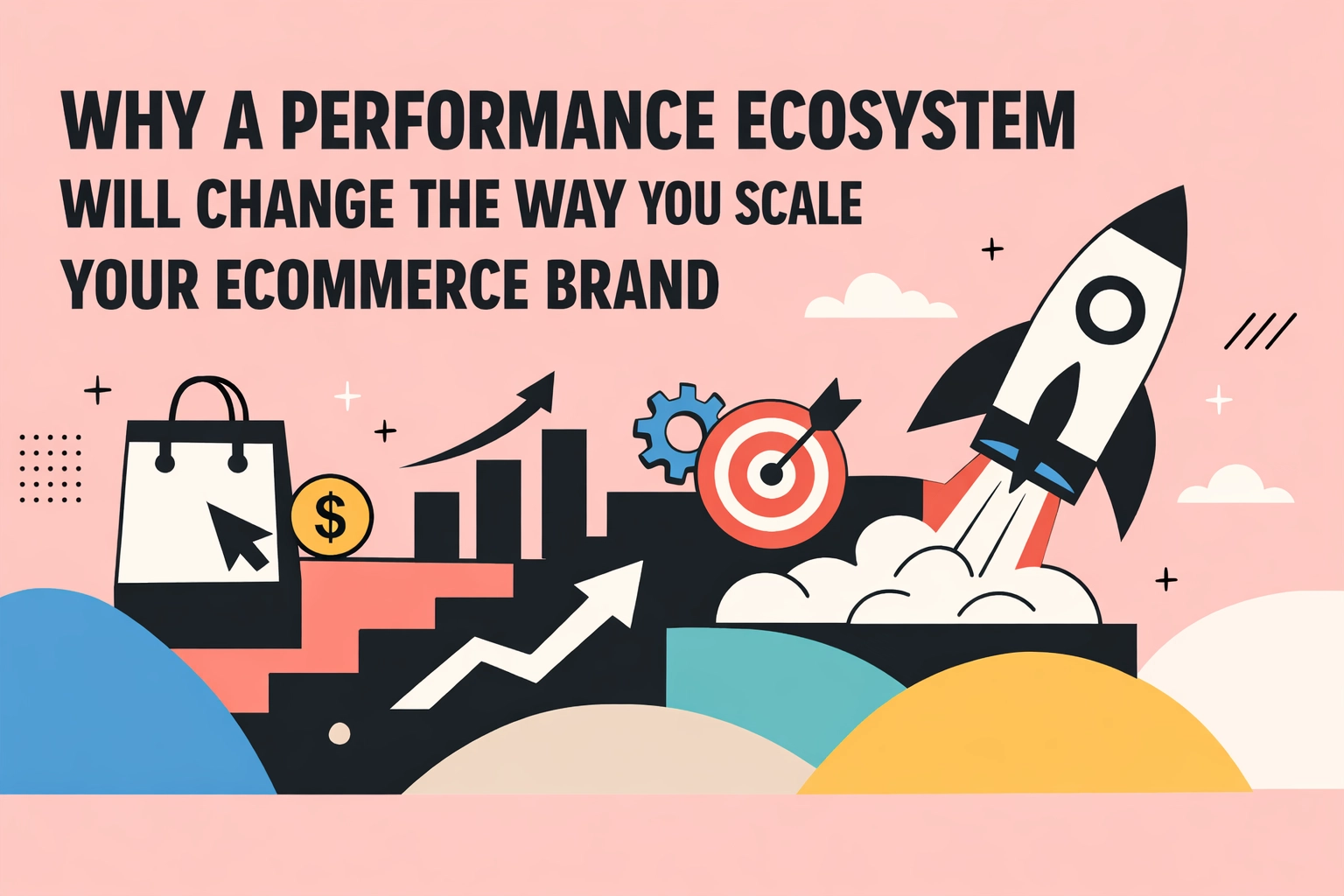
For years, the standard approach to scaling an ecommerce brand was simple: hire an agency to manage your ad accounts, increase the budget, and hope the algorithm delivered a return. In the early days of Facebook and Google Ads, this "set it and forget it" mentality often worked. However, as the digital landscape has matured: characterized by rising customer acquisition costs (CAC), stricter privacy regulations, and a saturated market: simply managing spend is no longer enough to achieve sustainable growth.
Scaling a brand in 2026 requires a shift from isolated ad management to a holistic Performance Ecosystem. This approach recognizes that marketing does not exist in a vacuum. Instead, it is a series of interconnected systems: creative, tracking, offer positioning, and backend operations: that must work in perfect harmony to turn advertising spend into predictable revenue.
The Problem with Traditional Ad Management
Many ecommerce brands reach a "scaling ceiling." They find that as soon as they push their daily spend past a certain threshold, their Return on Ad Spend (ROAS) plummets. This usually happens because the brand is treating its advertising as a standalone lever rather than a component of a larger system.
Traditional agencies often focus solely on the technical aspects of the ad platform. They tweak bidding strategies, adjust audience targeting, and manage keywords. While these tasks are necessary, they are secondary to the variables that actually drive conversion. When a brand relies on an agency that only manages "the buy," several critical issues typically arise:
– Creative Fragmentation: The ads being run do not align with the brand’s actual identity or the psychological triggers of the target audience.
– Tracking Gaps: Without precise attribution, brands struggle to understand which channels are truly driving value, leading to wasted spend on underperforming campaigns.
– Weak Offer Positioning: Even the best ad cannot save a mediocre offer. If the landing page experience and the "hook" aren't optimized, the traffic generated by ads will never convert at a profitable rate.
– System Fragmentation: Data is siloed across different platforms, making it impossible to see the "big picture" of the customer journey.
Defining the Performance Ecosystem
At JN Marketing, we have moved away from the "agency" model in favor of a Performance Ecosystem approach. This methodology focuses on building a unified, modular platform that centralizes operations and eliminates the friction points that prevent growth.
The ecosystem is built on three core pillars: Creative Strategy, Technical Tracking, and Offer Positioning. When these three elements are aligned, marketing stops being a game of guesswork and starts becoming a predictable engine for revenue.
1. Creative as the Variable
In a world of automated bidding and AI-driven targeting, creative has become the most important lever for performance. We no longer target people; we target interests through the content we put in front of them. Our ecosystem approach prioritizes UGC video content and motion graphic design elements that are designed specifically to stop the scroll and initiate a conversion.
Instead of producing one or two "hero" assets and hoping they work, a performance ecosystem utilizes a high-tempo testing framework. We iterate on hooks, visual styles, and calls-to-action to find the winning combinations that resonate with the new generation of customers.
2. Precise Tracking and Attribution
The death of third-party cookies and the introduction of iOS 14.5 changed the game for data. To scale, you need a technical foundation that allows for accurate, first-party data collection. Our ecosystem approach integrates advanced tracking solutions that provide a clear view of the customer journey across multiple touchpoints.
By implementing server-side tracking and robust attribution models, we ensure that every dollar spent is accounted for. This level of technical specificity allows us to identify high-value customer segments and optimize for Long-Term Value (LTV) rather than just the first click.
3. Offer Positioning and Conversion Rate Optimization (CRO)
Scaling is not just about getting people to your site; it’s about what happens once they arrive. Offer positioning involves more than just a discount code. It’s about the "why" behind the purchase. We analyze market trends and competitor data to position your products in a way that feels essential to the consumer.
This includes a Mobile-First Approach to landing page design. If your mobile site takes more than three seconds to load or has a confusing checkout flow, you are burning money. A performance ecosystem ensures the post-click experience is just as polished as the ad itself.

Scalability Without Limits: The Advantage of Systems
An ecommerce ecosystem fundamentally changes how you scale by providing a modular architecture. As documented in our services, this approach allows for Faster Time-to-Market. Instead of waiting on custom development cycles to test a new product or sales channel, the ecosystem is built to handle rapid iteration.
True Omnichannel Operations become possible when your data is centralized. By unifying product data, inventory, and customer information, you can provide a consistent experience across Meta, Google, TikTok Shop, and Amazon. This centralization eliminates manual data duplication and simplifies management, allowing the brand to scale its product catalog without performance degradation.
Furthermore, a cloud-native ecosystem supports thousands of SKUs and handles traffic spikes: such as those during Black Friday or major influencer launches: seamlessly. You are no longer limited by the "bandwidth" of your agency; you are supported by the strength of your system.

Moving from Guesswork to Predictability
When you stop viewing marketing as a series of disconnected campaigns and start viewing it as a performance ecosystem, the results are often dramatic. We have seen this transformation firsthand in our work with brands like Beyond and Ascend, where a system-first approach unlocked levels of growth that were previously unattainable.
By focusing on the Performance Ecosystem, we have helped brands achieve:
– Increased ROAS by 45% within the first 90 days of implementation.
– Grew revenue by 120% year-over-year by optimizing the conversion funnel.
– Surged customer retention rates through better data utilization and personalized backend marketing.
This approach is not just about doing "more" marketing; it is about doing "better" marketing. It is about building a foundation that allows you to spend more on ads because you know exactly what your return will be.

The JN Marketing Difference
JN Marketing functions as more than just a service provider; we act as a growth partner. Led by Jason Najem, our team focuses on the high-level creative and strategic initiatives that move the needle. We don't just give you a report on last month's spend; we give you a roadmap for next year's growth.
If you are tired of the agency cycle: where performance fluctuates and communication is sparse: it is time to consider a performance ecosystem. We invite you to contact us to discuss how we can build a scalable, predictable growth engine for your brand.