The Illusion of Efficiency in Modern Ecommerce
The landscape of digital commerce in 2026 has undergone a fundamental shift. For years, the gold standard of success was a high Return on Ad Spend (ROAS). If the dashboard showed a 4x or 5x return, the assumption was that the business was thriving. However, as experienced digital marketing consultants have observed, these platform-reported numbers have become increasingly disconnected from bank account reality.
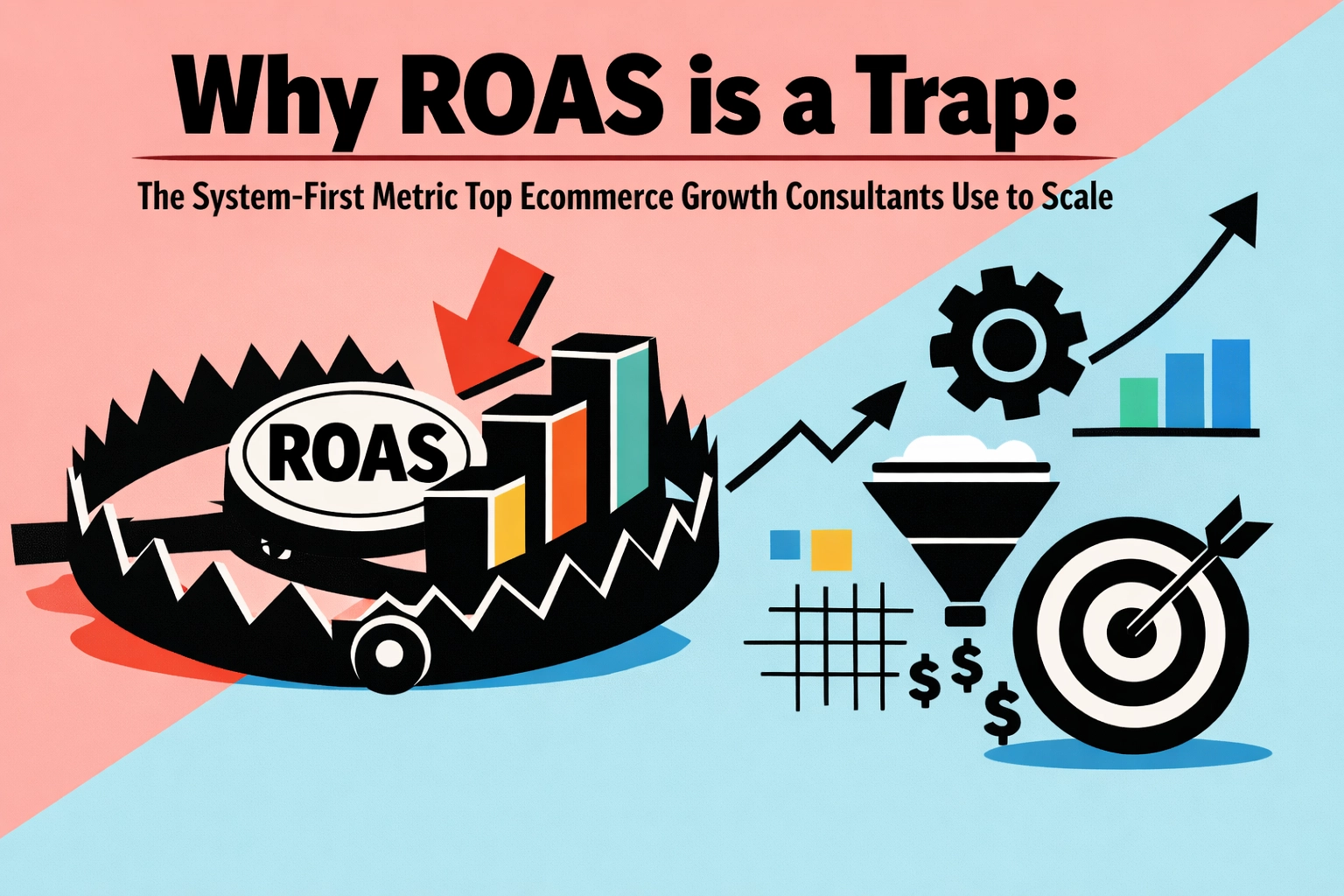
The reliance on platform-specific metrics has created a "ROAS Trap." Brands often scale their spend based on Meta or Google’s reported returns, only to find that their actual net profit is shrinking. This discrepancy occurs because ROAS is a siloed metric. It doesn't account for the cost of goods sold (COGS), shipping, returns, or the fact that different platforms often claim credit for the same sale.
To achieve sustainable growth, the focus must shift from chasing vanity metrics to building a cross-platform system. Top ecommerce growth consultants no longer look at ROAS as the primary indicator of health. Instead, they look at the system as a whole, focusing on how different channels interact to drive holistic profitability.
The Technical Limitations of the ROAS Trap
The primary danger of the ROAS trap lies in its methodological inconsistency. Research indicates that small choices in how ROAS is calculated: such as attribution windows or product categorization: can shift results by an average of 35%. When multiple methodological choices are combined, that shift can reach a staggering 63%.
Performance marketing agency experts understand that platform-specific ROAS is often misleading due to the following factors:
Attribution Gaps – Since the implementation of stricter privacy protocols and the evolution of cross-device shopping, tracking a single user's journey from a click to a purchase has become nearly impossible. Platforms use modeled data to fill these gaps, which often leads to over-reporting.
The Profitability Blind Spot – ROAS measures revenue, not profit. A campaign with a 3.0x ROAS generating $3,000 in revenue from $1,000 in spend might appear successful. However, after accounting for a 50% COGS, shipping fees, and overhead, the actual contribution margin might be negative.
Diminishing Returns – Advertising typically follows the law of diminishing returns. As spend increases, each additional dollar spent yields progressively less revenue because the most "ready-to-buy" audiences are exhausted first. High-level digital marketing consultants analyze marginal ROAS to identify when a brand is actually losing money by spending more.

The System-First Metric: Marketing Efficiency Ratio (MER)
To solve the limitations of ROAS, the industry’s top strategists have pivoted to the Marketing Efficiency Ratio (MER). Also known as the "Blended ROAS," MER is calculated by taking total revenue and dividing it by total marketing spend across all channels.
Unlike ROAS, MER provides a "bird's-eye view" of the entire marketing ecosystem. It accounts for the halo effect: the reality that a customer might see a Meta ad, search for the brand on Google, and finally purchase after receiving an email. In this scenario, Meta and Google might both claim credit for the sale in their respective dashboards, but MER looks at the business as a single unit.
Why MER is the Key to Scaling
Holistic Accountability – By focusing on MER, a performance marketing agency can see how a high-funnel awareness campaign on YouTube is actually driving a lift in direct and branded search traffic.
Simplified Decision Making – MER removes the noise of attribution debates. If the MER is within the target range for profitability, the overall system is working, even if one specific platform shows a dip in reported ROAS.
Margin Protection – By integrating COGS into the target MER calculation, brands can ensure that every dollar of revenue contributes to the bottom line rather than just feeding the ad platforms.
LTV vs. ROAS: The Long-Term Play
Another critical flaw in the ROAS-centric model is its focus on the first transaction. In 2026, the cost to acquire a customer (CAC) has risen to a point where many brands break even or lose money on the initial purchase.
An ecommerce growth consultant focuses on Customer Lifetime Value (LTV) rather than immediate return. A brand that is willing to accept a lower initial ROAS to acquire a high-quality customer who will purchase four times a year is positioned to dominate its market.
Standard agencies often optimize for the "quick win," targeting low-hanging fruit and discount-heavy shoppers. JN Marketing takes a different approach, building systems that prioritize customer retention and brand equity. By analyzing LTV-to-CAC ratios, it becomes possible to identify which acquisition channels are bringing in the most profitable long-term customers, even if their initial ROAS is lower than average.

JN Marketing: Building a Predictable Growth System
JN Marketing is not a traditional agency that simply manages ad accounts. The team positions itself as a strategic partner that turns marketing into a predictable system. While standard agencies focus on vanity metrics that look good in monthly reports, JN Marketing focuses on the metrics that actually scale a business.
The system-first approach involves several key pillars:
Cross-Platform Integration – Rather than running isolated campaigns, the strategy involves building a cohesive funnel where Meta, Google, TikTok, and Email work in tandem.
Data-Driven Creative – In a world where algorithms handle much of the bidding, creative content is the biggest lever for growth. The focus is on UGC video content and motion graphic design elements that are engineered to convert, not just to look pretty.
Operational Alignment – JN Marketing works closely with founders like Jason Najem to ensure that marketing spend is aligned with inventory levels, cash flow, and operational capacity.
Predictable Scaling Framework – By utilizing MER and contribution margin tracking, the team can identify the exact "inflection point" where spend can be aggressively increased without sacrificing profitability.
Results Through System Thinking
By moving away from the ROAS trap, brands have seen significant shifts in their bottom-line performance. The focus on a "System-First" approach allows for more aggressive scaling and better long-term stability.
- Total Revenue Growth: Increased by 140% year-over-year.
- Blended MER: Improved from 2.8x to 4.2x through channel optimization.
- Customer Retention: LTV grew by 35% post-revamp of the post-purchase experience.
- Acquisition Efficiency: CAC decreased by 22% across the entire ecosystem.
The transition from a siloed marketing approach to a system-first strategy has allowed clients to reach a new generation of customers while maintaining healthy margins. As seen in recent case studies, the results of this methodology speak for themselves.

Moving Beyond Vanity Metrics
The era of scaling an ecommerce brand based solely on Meta's 7-day click attribution is over. Those who continue to chase high ROAS without understanding their MER and LTV will find themselves struggling against rising costs and diminishing returns.
JN Marketing exists to bridge the gap between complex data and actionable growth. As a performance marketing agency that prioritizes systems over silos, the goal is to provide founders with the clarity they need to scale with confidence.
Strategic Initiatives for 2026:
- Audit existing attribution models – Identify where platforms are over-reporting or overlapping.
- Establish a target MER – Determine the blended return needed to maintain profitability after all expenses.
- Focus on retention – Build systems that maximize the value of every acquired customer.
- Optimize for contribution margin – Ensure that scaling spend results in scaling profit, not just volume.
For brands looking to escape the ROAS trap and build a sustainable, predictable growth engine, the next step is a strategic evaluation of the current marketing ecosystem.
> "The shift from ROAS to MER was the turning point for our business. We finally stopped guessing which ads were working and started seeing real, bottom-line growth. JN Marketing provided the strategic framework we needed to scale past our previous plateaus."
> : Marketing Director, Ecom Growth Partner
Take the Next Step
Scaling a brand requires more than just a higher ad budget; it requires a superior system. JN Marketing is the team that turns marketing into a predictable system for high-growth ecommerce brands.
To see how a system-first approach can transform your business, explore the JN Marketing About page or learn more about the services offered.
Ready to stop chasing ROAS and start scaling profit?