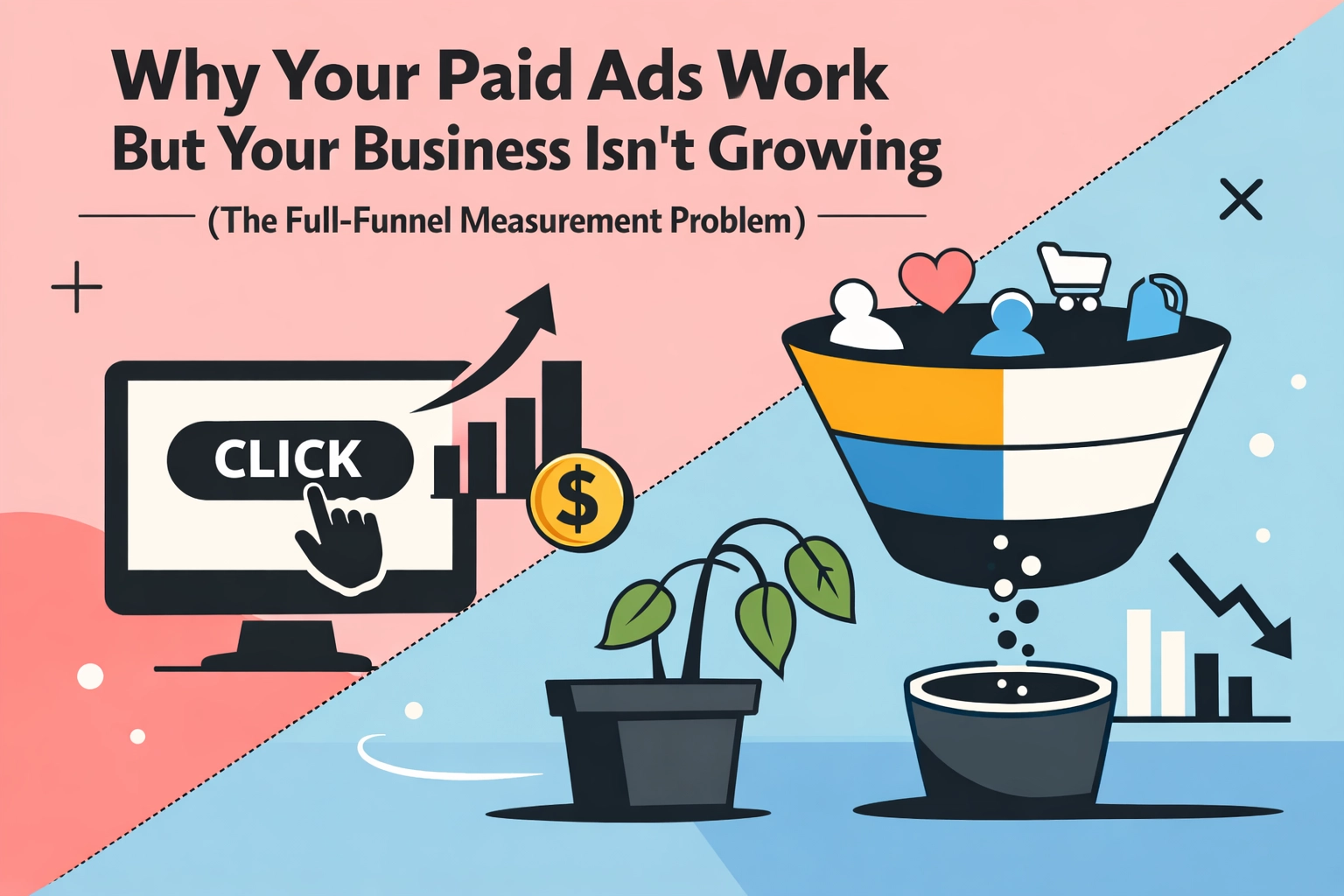
Let me guess: Your dashboard looks great. ROAS is climbing. Cost per acquisition is down. Your paid media agency is sending you screenshots of winning campaigns every week.
So why the hell isn't your business actually growing?
Here's the uncomfortable truth: Your paid ads are probably lying to you. Not because the numbers are wrong, but because you're measuring the wrong things. And most performance marketing agencies are perfectly happy to keep it that way, because optimizing for ROAS is way easier than building systems that drive real growth.
The ROAS Trap (And Why Your Agency Loves It)
ROAS, Return on Ad Spend, has become the golden metric everyone obsesses over. Spend $1, make $5 back. Looks good in a spreadsheet. Makes your agency look like heroes.
But here's what ROAS doesn't tell you:
- Whether you're actually acquiring new customers or just retargeting the same people who were already going to buy
- If your customer acquisition cost is sustainable long-term
- Whether your customers come back and buy again
- If your overall business revenue is growing or just churning through the same small pool
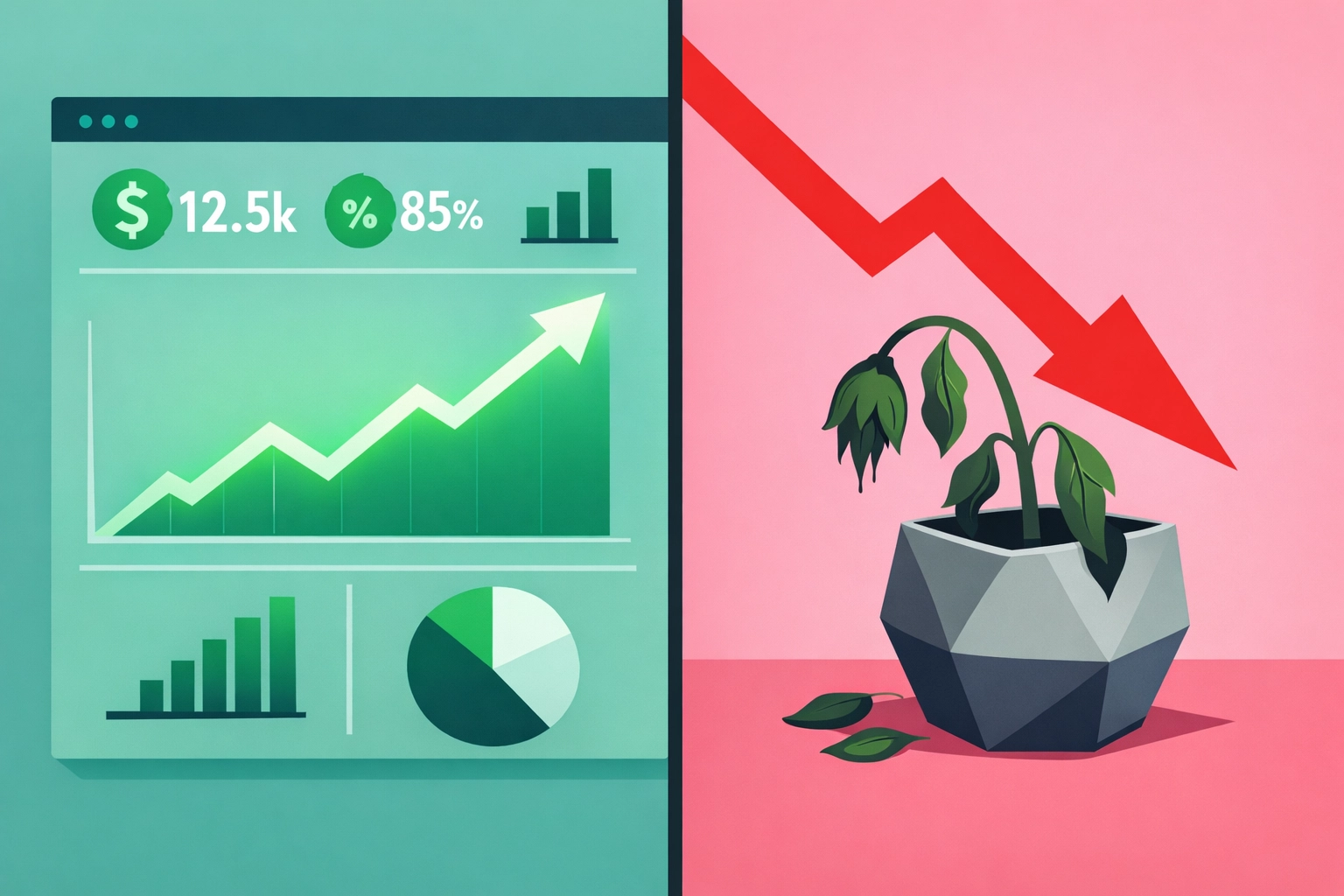
ROAS measures efficiency, not effectiveness. And there's a massive difference.
You can have a 6X ROAS and still be slowly killing your business. How? By only targeting bottom-funnel, high-intent audiences, people who already know your brand and are ready to buy. Your ads convert great because you're cherry-picking the low-hanging fruit. But you're not building awareness, you're not expanding your market, and you're not creating sustainable growth.
You're optimizing yourself into a corner.
What You Should Actually Be Measuring
If ROAS is the vanity metric, what's the reality check? Here's what actually matters if you want your business to grow:
Marketing Efficiency Ratio (MER) – This is your total revenue divided by total marketing spend. Unlike ROAS, which can be gamed by attribution windows and platform reporting, MER shows you the real picture. It doesn't care which platform gets credit. It just shows whether your overall marketing investment is driving business growth.
Formula: Total Revenue ÷ Total Marketing Spend = MER
If your ROAS is 5X but your MER is 2X, you've got a problem. Your ads might look efficient in isolation, but your overall marketing system is broken.
Customer Lifetime Value (LTV) – What's a customer actually worth to you over time? If you're only looking at first-purchase metrics, you're flying blind. A customer who spends $50 once isn't the same as a customer who spends $50 every month for two years.
Most ecommerce marketing agencies optimize for that first sale because it makes their reports look good. But if your LTV is low, you're on a treadmill, constantly spending to acquire customers who disappear after one purchase.
Actual Bottom-Line Growth – Revolutionary concept: look at your bank account. Is your profit growing? Not revenue, profit. Because you can scale revenue all day long while watching margins evaporate.

The Full-Funnel Measurement Problem
Here's where most businesses completely fall apart: they're measuring every stage of the funnel in isolation.
Your awareness campaigns get judged on immediate conversions. Your consideration content gets ignored because it doesn't directly drive sales. Your retargeting looks like a superstar because it gets the last-click credit.
This creates a death spiral:
- Upper-funnel awareness campaigns show "poor ROI" because they don't immediately convert
- Budget gets pulled from awareness and dumped into bottom-funnel retargeting
- Short-term metrics improve (yay, ROAS is up!)
- But you stop feeding new people into the top of the funnel
- Your addressable market shrinks
- Acquisition costs rise because you're fighting over the same small audience
- Growth plateaus, then declines
You optimized your way out of growth.
The research backs this up: businesses that focus exclusively on conversion metrics end up competing for the same pool of ready-to-buy customers instead of expanding their market. You're not building a business: you're strip-mining a limited resource.
Different Stages, Different Metrics (Stop Judging Everything on Conversions)
Top-of-funnel content shouldn't be measured the same way as bottom-funnel ads. That's like judging a first date by whether you got married.
Top of Funnel – Measure reach, awareness, and whether people remember your brand. Video views, engagement rates, brand lift studies. You're planting seeds here, not harvesting crops.
Middle of Funnel – Measure consideration and intent signals. Email signups, add-to-carts, site visits, content engagement. People are evaluating whether you're worth their money.
Bottom of Funnel – Now you can measure conversions and revenue. This is where ROAS actually makes sense: but only if you've got a healthy full funnel feeding into it.

The problem? Most agencies skip straight to bottom-funnel because that's where the "proof" lives. It's easier to show a client a 4X ROAS on conversion campaigns than to explain why a brand awareness campaign that didn't immediately convert was actually essential to long-term growth.
Why Most Agencies Just Manage Accounts (Instead of Building Systems)
Let's talk about why your current agency probably isn't solving this problem.
Running ads is easy. Seriously. Anyone can set up a Facebook campaign or Google Ads account. The platforms practically do it for you at this point.
Building a full-funnel measurement system that connects awareness to consideration to conversion to retention? That's hard. That requires:
- Setting up proper analytics infrastructure
- Implementing multi-touch attribution
- Running incrementality tests to prove what's actually working
- Building dashboards that show business metrics, not just platform metrics
- Having uncomfortable conversations about why vanity metrics don't matter
Most paid media agencies don't want to do that work. It's easier to show you rising ROAS numbers and collect their monthly retainer.
And here's the other dirty secret: if they actually built you a system that showed the full picture, you'd realize how much wasted spend there is in your current setup. You'd see which channels aren't pulling their weight. You'd understand why your business isn't growing despite "good" ad performance.
They'd have to actually prove their value instead of hiding behind platform metrics.
What Actually Needs to Happen
If you're serious about fixing this, here's what needs to change:
Stop optimizing for ROAS in isolation. Start tracking MER, LTV, and actual profit growth. These are the numbers that show whether your marketing is building a business or just creating busy work.
Build a full-funnel strategy. You need awareness campaigns that feed consideration campaigns that feed conversion campaigns. And you need to measure how they work together, not in isolation.
Implement proper attribution. Multi-touch attribution isn't perfect, but it's better than last-click. You need to understand the customer journey, not just the final step.
Run incrementality tests. The only way to know if your marketing actually works is to turn it off and see what happens. Controlled experiments beat dashboard metrics every time.
Partner with an agency that builds systems, not just manages accounts. Look for an ecommerce marketing agency that talks about business outcomes, not platform metrics. One that asks about your profit margins and customer retention before they ask about your ad budget.
At JN Marketing, we don't just run your ads: we build the measurement infrastructure that shows whether your marketing is actually driving growth. We care about your bottom line more than our dashboard screenshots.
Because here's the reality: if your paid ads are working but your business isn't growing, the ads aren't the problem. Your measurement system is the problem. And until you fix that, you're just going to keep chasing vanity metrics while your business stagnates.
Want to actually understand what's driving (or killing) your growth? Let's talk about building a measurement system that shows the truth( even when it's uncomfortable.)